


NCAA Football lost a true legend
- Don Glenn

- Apr 11
- 5 min read

On Wednesday, March 4th, the entire world of NCAA Football said goodbye to one of the most beloved and respected coaches in the game, A true legend, Lou Holtz. Lou was 89 and reportedly passed away at home, surrounded by family and friends. There has been no official cause of death released.
Born Louis Leo Holtz on January 6, 1937, in Follansbee, West Virginia. He grew up in East Liverpool, Ohio. He earned a bachelor's Degree from Kent State University in 1959. He was a walk-on on the football team, a member of the US Army ROTC, and earned a commission as a Field Artillery officer in the Army Reserve.
In a career that spanned 44 years, covering 1o different stops in 5 College Conferences, plus Notre Dame and the NFL. Three conference Championships 2 National Championships, and multiple honors.
He started his coaching career as an Assistant at Iowa and had stops at William and Mary, Connecticut, South Carolina, and Ohio St. He was on the staff of Ohio St. when they won the National Championship in 1698.
His head coaching resume.
He landed the head job at William and Mary (1969-1971), (13-20). While the record was not good, but he did lead them to a Southern Conference Title in 1970. They lost in the Tangerine Bowl.
From there, he went to North Carolina State (1972-1975), (33-12-3). He guided them to the ACC crown in 1973. NC State finished second in 1972 and 1974, and they went 2-1-1 in bowl games under Holtz.
After a one-year stint in the NFL as the head coach of the New York Jets (1976), (3-10). he went back to the college game.

He went to Arkansas (1977-1983), (60-21-2). winning a SWC co-championship in 1979 and going 3-2-1 in bowl games. In his first year at Arkansas (1977), he led them to an Orange Bowl win over Oklahoma, which was largely responsible for Oklahoma not being ranked as the national champions. There was controversy when he left; the original story given was that he resigned. It was later revealed that he was fired by AD Frank Broyles because he was losing the fan base. Holtz claims he was never given a reason.
at his next stop, Minnesota (1984-1985), (10-12). Minnesota did qualify for a bowl game, but Holtz had left the program for Notre Dame. It was written into his contract that the university give him permission to apply for the Notre Dame job should it come open during his tenure. Five years after his departure, the NCAA implicated the university in recruiting violations that occurred when Holtz was head coach. Minnesota was banned from bowl play in 1992 and was given two years of probation.

Next stop was The Fighting Irish of Notre Dame (1986-1996), (100-30-2). He led the Irish to nine bowl games in 11 years, going 5-4. This is probably the position most fans associate with him. He had five out of six seasons from 1988 to 1993, each with at least 10 wins. In 1988, the Fighting Irish went 12-0, beat West Virginia in the Fiesta Bowl, and were voted National Champions. In 1993, despite an 11-1 record and a win over Florida State (FSU's only loss). Notre Dame was ranked second because of a loss to 7th-ranked Boston College at the end of the season, and FSU was selected as the national champion in the AP poll. Under Holtz, the Irish went to nine straight bowl games from 1987 to 1995, a Notre Dame record. The only blemish on his time in South Bend was, in 1999, when the NCAA imposed sanctions on Notre Dame for circumstances involving an outside booster and academic fraud that occurred under the previous head coach. The NCAA cited Holtz and his staff for failing to take appropriate action after learning of the violations.
During a brief two-year retirement, which included being an analyst for CBS. It was rumored that the Minnesota Vikings tried to lure him back to the NFL, but he turned them down.
He would accept an offer to coach the South Carolina Gamecocks (1999-2004). Even though he did not enjoy the same success he had at previous stops (33-37), he had back-to-back bowl wins in the Outback Bowl (2000 and 2001). After he left in 2005, the program self-reported 10 recruiting violations for which the NCAA leveled a one-year probation and two scholarship reductions but did not ban them from TV or postseason participation. After the announcement was made by the NCAA, Holtz then issued this statement: "There was no money involved. No athletes were paid. There were no recruiting inducements. No cars. No jobs offered. No ticket scandal."(via USA Today).
After he left South Carolina, he retired from coaching again and returned to broadcasting, first with CBS and then with ESPN from the Bristol Studio. He would retire completely in 2015.
Lou Holtz was known as a motivator who relied on discipline and teamwork. His belief in discipline was fully on display in the 1978 Orange Bowl game, when, hours before they took the field, he suspended his two starting running backs and his top wide receiver for violating team rules. He was and still is praised for his ability to lead the young men entrusted to him.
He received numerous coaching awards in his career:
Paul “Bear” Bryant Award: 1977, 1988
Eddie Robinson Coach of the Year: 1977, 1988
Sporting News College Football Coach of the Year: 1977, 1988
Walter Camp Coach of the Year: 1977
Woody Hayes Trophy: 1977, 1988
SEC Coach of the Year: 2000
ACC Coach of the Year: 1972
SWC Coach of the Year: 1979
Man of the Year, Walter Camp Foundation: 1997
He also received numerous awards outside of coaching
Elected to the Arkansas Sports Hall of Fame in 1983
He received the Golden Plate Award of the American Academy of Achievement in 1990
The Upper Ohio Valley Museum & Learning Center at the Lou Holtz Hall of Fame was established in his hometown of East Liverpool, Ohio, where he was inducted into its inaugural class in 1998.
Elected to the College Football Hall of Fame in 2008
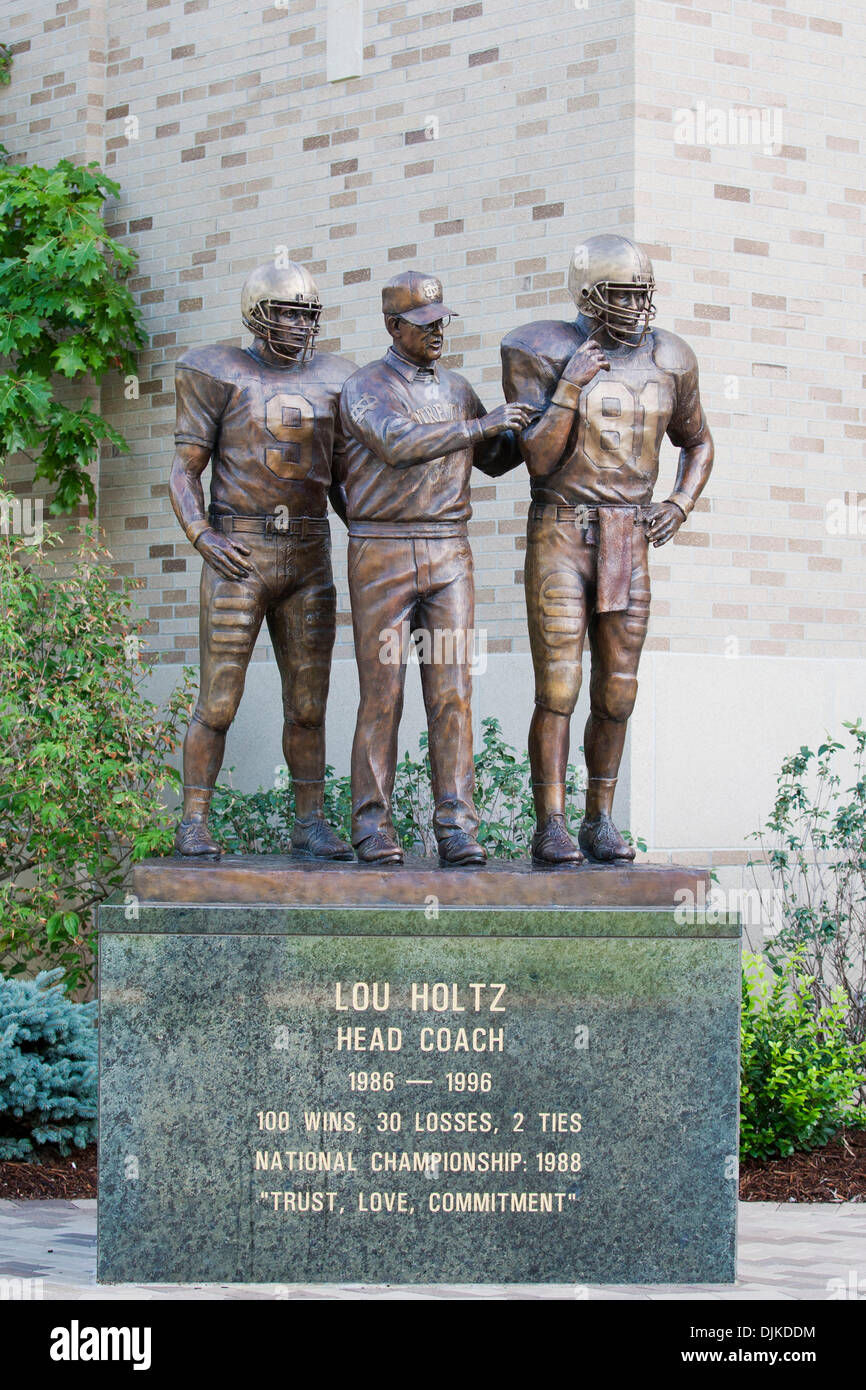
Sep. 04, 2010 - South Bend, Indiana, United States of America - Lou Holtz statue at the stadium. NCAA football game between the Notre Dame Fighting Irish and the Purdue Boilermakers. Notre Dame defeated Purdue 23-12 in game at Notre Dame Stadium in South Bend, Indiana. (Credit Image: © John Mersits/Southcreek Global/ZUMApress.com) A statue was erected at the University of Notre Dame in his honor in 2008
Holtz was awarded numerous honorary degrees. He was awarded an honorary Doctor of Laws from the University of Notre Dame in 2011.
Holtz received an honorary Doctor of Public Service from Trine University and was elected to the board of trustees in 2011
He was selected for the Cotton Bowl Hall of Fame in 2012.
Holtz was awarded an honorary Doctor of Education from the University of South Carolina in 2012.
He was presented with an honorary Doctorate in Communications from Franciscan University of Steubenville in 2015
He was awarded the Presidential Medal of Freedom by President Donald Trump in 2020.
Lou Holtz was a powerful figure and one of the more interesting characters in college football, and one who will be greatly missed.


Comments